The cost guide · Summerville & Dorchester County
Tree Removal Cost in Summerville, SC
Itemized before the saw starts.
Most people asking about tree removal cost in Summerville want two things: the number a normal tree runs, and what turns a normal tree into an expensive one. Both are below, using the ranges published across this site.
The short answer, in one table
Two ranges cover most of the work in this town, and a third line covers the storm weeks. Everything else on a quote is an option you can take or leave.
| Most removals | $450–$1,200. One yard tree a climber can reach, with nothing expensive under it. |
|---|---|
| Large pines and oaks | $900–$2,000, and past it when a crane or traffic control has to be brought in. |
| Storm-week emergencies | Two to three times normal. The storm page explains the reason, and when a week’s wait is the cheaper move. |
| The town permit | $10, paid to the town with the application. It sits on the quote as its own line so you can see it is the town’s fee, not the tree company’s. |
| Stump grinding | Its own optional line. A lone modest stump often lands around a hundred dollars or two, and it is priced lowest when it rides the removal quote. |
| A pruning cut instead | Clearing the deadwood out of one tree usually comes to a few hundred dollars, and plenty of removal worries end there, because the tree has years left in it. |
Two pines, same height, two different numbers
Picture two sixty-foot loblollies with the same brown needles. The first stands in a front yard with the driveway beside it. The company drops the top in a few big sections, the trunk comes down in rounds, and everything loads straight onto the trailer. That tree lives near the bottom of the range.
The second stands eight feet off the back of the house, over the screened porch and the service drop, behind a fence gate the width of a wheelbarrow. Every limb is roped and lowered, the trunk comes down in short pieces, and each of those pieces walks out through the gate by hand. Same species, same height, and this one sits at the top of the range — not because anyone is being greedy, but because it takes far more crew hours and all of the rigging.
Size, targets, access, and debris: those are the four lines on every quote, and they are the whole difference between one number and another. The removal page lays each one out; this page is about what they do to the price.
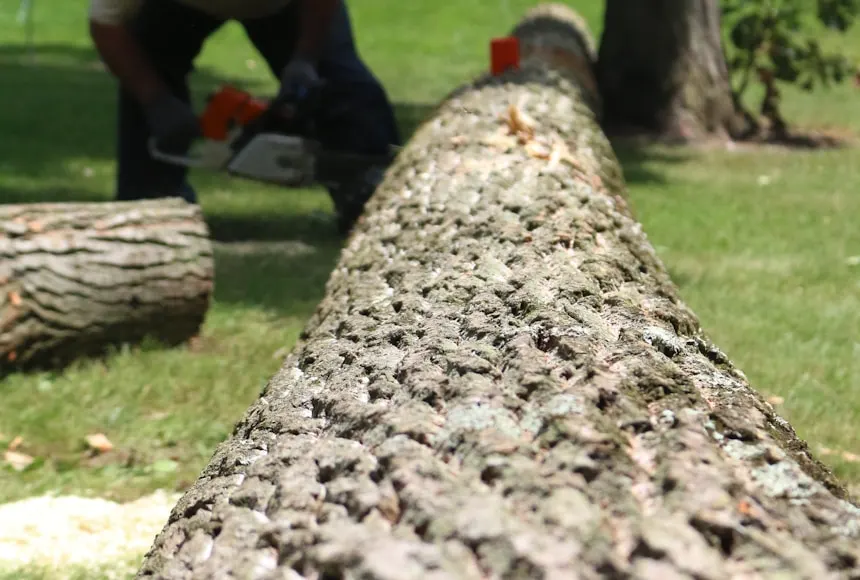
What the number actually pays for
A removal price is mostly people-hours and machine-hours. Climbing and rigging time, the ground crew feeding the chipper, the truck and trailer, the dump fee on what leaves, and the drive there and back. A tree that takes a morning and a tree that takes a full day with a lift are priced a long way apart because they are a long way apart.
What is not in the number: a charge for looking. The tree company comes out, measures the trunk at chest height, photographs the defect and the targets under it, and hands you the written figure. The price moves only if the job moves — a second tree added, a gate that turns out to be padlocked, that kind of thing.
Three ways to spend less
- Do not let a dead pine stand into fall. A pine that browned out in spring is a climb job in June and can be a lift or crane job by October, because a beetle-killed pine loses its strength within months. The same tree, taken down early, is an ordinary removal at an ordinary price. Beetles, rigging near the roof and the permit rules that pines share with every other tree are laid out on the local guide to felling a tall loblolly.
- Do the storm work before the storm. Storm-week work is priced at two to three times normal because the tree is under load and the company is working through a queue of other wrecks. A pre-season pruning pass on the overextended limbs, or a scheduled removal of the leaner, is the same wood at normal rates.
- Bundle the stump, keep the wood. Stump grinding priced on the same quote as the removal skips a second trip. Keeping the firewood or the chips drops the debris line. Both are your call, and both are separate lines, so you can see exactly what each one saves.
Cost questions, answered straight
Is stump grinding included in the removal price?
It is quoted as its own line, and you decide. Add it at the same visit and it is priced as low as it ever will be, because the machine came on the same trailer. Skip it and you pay nothing today, plus a trip charge if you call back for it later. The stump page explains the three ways a ground stump can be finished.
Why does a storm removal cost two to three times more?
Because the work changes. A tree that has failed onto a roof is loaded in ways a standing tree is not, so freeing it without adding to the damage is careful, unhurried rigging, usually at a bad hour, with other emergencies waiting. Once a tree is down on open ground and done moving, it is not an emergency anymore, and the sensible move is to book it as a normal removal the following week.
Is a dead tree cheaper to remove than a live one?
Usually the opposite, in this town. Dead pines lose their strength quickly, and once a trunk is unsafe to climb the job needs a lift or a crane instead of a climber. Get eyes on a browning pine this season rather than next. The removal is cheaper while the wood is still sound.
Two numbers, one visit.
Tell us what is standing and what is under it. You get the figure in writing, the permit line on it, and an independent company that shows up on the agreed day.